Submitted by Brenda Willman
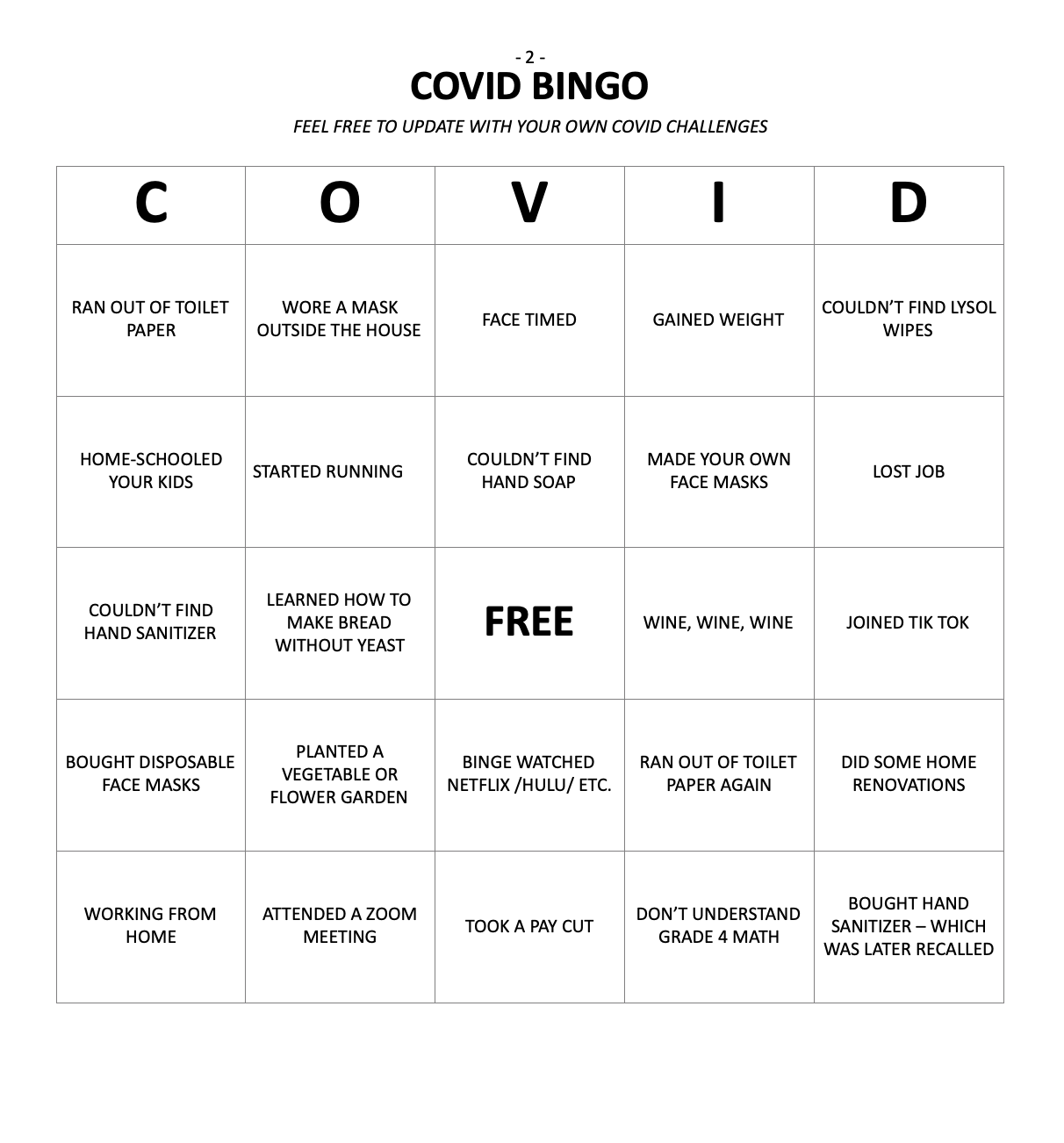
Covid "seek a word" and COVID BINGO - I made them up both myself...but suspect there might be other COVID Bingo games out there - it's not that unique.
This is the
VOICE OF SUNNYHILL
Submitted by Brenda Willman
Covid "seek a word" and COVID BINGO - I made them up both myself...but suspect there might be other COVID Bingo games out there - it's not that unique.
Submitted by Richard Harrison, on behalf of the Board
Hello fellow Co-oppers,
I’m writing to catch up on the week since the Board meeting, and give you a couple of pieces of information regarding Saturday’s General Meeting as well. The majority of that meeting will be taken up with discussion of Planning and Development’s presentation, as it should be, so I’ll be brief.
Celebrating the Past: the Co-op Birthday
The recent past first: Congratulations and thanks to the Social Committee for setting up one of the most fun and memorable Co-op Birthdays in the 42-year history of our great experiment in team living. I’ve known Dan the One Man Band a long time, and I’ve rarely seen him in such fine form, chasing the laughing children in the way that only someone of whom one child could ask “Are you Santa?” can do and make them laugh even more. And of course, playing the oldies for the audience who love to smile at what we remember. Then: Hire Heels YYC, a Calgary Drag Queen trio, delightful, witty and risqué in a way that only the most clever and sensitive are with grown-up humour when they have a family audience. And no one’s going to forget this improvised number from Sunnyhill’s own (co-op member-built) playground: https://www.facebook.com/HireHeelsYYC/videos/306459357102090.
Looking to the Future: General Meeting Focused on Planning and Development
The upcoming meeting will provide an update on the ongoing work of our Planning and Development Committee. In the past month or so, a lot has happened: the open sessions on MODA’s drawings for the proposed development as reported by the Communications Committee in their mid-August newsletter, negotiations with the city for purchase of our land, developments in our grant proposals. And a lot is still ongoing. This will be a good meeting to bring us all up to date, and to lay the groundwork for the decisions we will need to make in the coming months. I look forward to hearing from our Committee.
Bringing the Past into the Present 1: The Motion about the Dryer Vents
There is one other item on the agenda for this meeting. At the last Board meeting, Buildings presented us with a recommendation for work to be done based on our furnace and ductwork contractor’s assessment of our single-bedroom units. These are currently venting dryer air into the crawl space beneath them. This arrangement is not in compliance with the current buildings code, which to vent dryer air and lint out through the wall (the way it is with our two- and three-bedroom units). However, it is not compulsory that we change it to fit those codes, although rerouting the vents would be that much safer in terms of fire hazard, and less likely to lead to a build-up of mould.
Now it’s true that this situation has been in place since the Co-op was built, so it will be up to us as a whole, since the expenditure is as stated in the motion, to assess the situation, and decide if we want to go ahead or not.
Bringing the Past into the Present 2: Answers to the Questions about the TELUS Fibre Optic Plan.
Last meeting left us with several questions regarding TELUS’s proposal to update our internet access by replacing the current system with a fibre optic one. The result will be more efficient and reliable internet. Here are the questions we were left with in our deliberations, the answers we have today. Let me quote from Andrea’s summary of her discussion with TELUS:
Will it be more efficient?
Yes. There will be no issues with port capacity with the fibre upgrades.
Will it be more reliable?
yes
Is there a bulk usage bargain?
Yes, the SACHA agreement is a 40% discount on residential internet and TV services. All residents will benefit from the 40% discount with the fibre upgrades.
Could TELUS provide a Fiber optics community cable that would provide Wi-Fi access to Sunnyhill grounds as well as in the homes?
Yes, Ankit and team may look at the site and determine the best location to support this request.
I will attach the supporting documentation to this letter.
Bringing the Past into the Present 3: A Matter of Minutes
You’ll have noticed that there is no mention of the minutes question, which has been an ongoing discussion, in the agenda for this meeting. Partly, this is because of time-dependent considerations. Planning and Development is our first priority right now, and what the Committee will be talking about should get our attention in as full and complete a way as possible. Zoom meetings have many advantages, but being less tiring than in-person conversation isn’t one of them. So as much as possible, the Board will arrange meetings to be as efficient and focused as we can.
The other reason for moving the minutes discussion to our next meeting is because, as we have seen, it is a contentious one, so we are going to need some time to work it through. This week’s meeting is about coming together to make decisions to move forward as a coop as a whole. The minutes discussion is, in part, about moving on one of the recommendations from our June 7 meeting to repair past damages to our functioning as a group. These are two very different tasks, requiring different mindsets; for now, the first cannot wait, the second can.
So I need to ask for your patience while the Board prepares a presentation on this matter – including all the minutes that require the community’s approval – at the next General Meeting. And we can return to that discussion at that time.
Thanks,
See you Saturday,
for the Board, Richard Harrison, Chair
Submitted by Brenda Willman
BACK OR FRONT, YOU DECIDE – for entertainment purposes only
I am re-hashing and re-editing one of my previous articles from years ago, for the benefit of those who didn’t have the chance to read it and ponder the answer to the question “where is my front door?”.
Slide back years and years to grid-style neighbourhoods, such as the one we currently live in, where
· the front door of the house is on the street/avenue, and the living room is at the front, and the mailbox is at the front, with a fenced, shorter yard; and
· the back door of the house is on the side of the (back) lane, and the kitchen is on that side, and a longer yard, with a garage, or at least space to park the car. Until people in grid style neighbourhoods started commandeering their back yards for gardens, and their garages for suites, people parked in the back and didn’t militantly guard the spot in front of their houses on the street/avenue.
(Grid plan neighbourhoods have been in existence since 2600 BC – they’re hard to beat!)
Fast forward to the post-war era, with its accompanying boom in personal ownership of automobiles, plus a post-war house-building boom. “Curvilinear” street designs are thought to have been an early response to worrisome pedestrian/automobile encounters, which had become more frequent (and fatal). The design pattern was like a tree, with the main road being the trunk and the sub-roads were branches of that tree, including cul-de-sacs, and semi-circles, and bays, with garages attached at the front of the house- with the result being a back lane was unnecessary. The traffic was “quieted/subdued” and the vicinity around the house was quieter as well. The ‘burbs were born, and in those ‘burbs you will find:
· the front door of the house is on the cul-de-sac, mews, circle, bay (what-have-you), and the living room is on that same side, with the mailbox AND a garage???, with not much of a yard, and no back lanes; and
· the back door of the house opens onto the main yard – no parking here, and the kitchen (and more recently the great room) are located on that side as well.
So I sit today gazing out what I fondly refer to as my back window, looking at what I would define as a ‘back lane’, all while sitting in my unit located within a housing complex which is completely based on a grid style set up. What also happens to be located on the same side of the house I am presently sitting in are:
· the kitchen – CHECK –it’s supposed to be right here, at the back
· the mailbox - ??? – it’s in the wrong place????
· the parking spot – CHECK hmmmm – maybe?? – could be either front or back!
Most Co-opers would argue that I was looking out of my front window and I often have confusing conversations with my neighbours as I constantly refer to the ‘yard’ side as the front, and the driveway side as the back, having simply conceded that, for whatever reason, the designers accidentally placed my mailbox by the back door. In fact, when I first came to view my unit, I went to the balcony/garden side, assuming that was the front, and rang the doorbell, only to be met by astonished people who asked what I was doing at that door, and to please go around to the other side. Come to think of it, the gas meter was/is on that side, and that is DEFINITELY a ‘back yard’ sort of installation. Ooooh it’s all so confusing.
Anyway, in an attempt to truly understand where is the front and where is the back, I tried to look at the front v. back in another, more logical, way - through the actual location of streets, avenues and lanes (and where they would be if they still existed). But looking at it that way led to only more confusion.
For ease of following my logic, I will refer to the location of the mailbox when determining which is front or back.
Members on Third Street
For members living on the 700 block of 3rd Street there is no question as to which side is which.
· there is a front street (3rd Street) on the side where their driveway, mailbox and kitchen are located and
· there is a back lane on the other side, where their living rooms are located
· CONCLUSION – THE MAILBOX IS LOCATED BY THE FRONT DOOR (even though, much to my chagrin, so is the kitchen)
For the people living on the 800 block of 3rd Street we have a VERY mixed bag:
For 801 – 813, were 7th Avenue still continuing along its previous course, the driveway and kitchen would be at the front, and the living room would, by default, be at the back (and we would be living on 7th Avenue and not 3rd Street, but I digress…).
· CONCLUSION – THE MAILBOX IS LOCATED BY THE FRONT DOOR (again much to my chagrin, and I steadfastly stand by my decision that is my BACK door)
For those in 815 – 827, the balcony/living room side of the unit would have faced 7th Avenue, making the kitchen/driveway side the back.
· CONCLUSION – THE MAILBOX IS LOCATED BY THE BACK DOOR
For those in 837-849, following similar logic as to 4th Street continuing along its previous course (even though they have an address on 3rd Street – it rightfully would be 4th Street), their balconies and living rooms all would face 4th Street – making the kitchen/driveway side of the house the back
· CONCLUSION – THE MAILBOX IS LOCATED BY THE BACK DOOR
Members on Fourth Street
For members living from 734 – 748 4th Street, we find a similar situation to the 700 block of 3rd Street.
· there is a front street (4th Street) on the side where their driveway, mailbox and kitchen are located and
· there is a back lane on the other side (which again must be extended in one’s imagination), where their living rooms are located
· CONCLUSION – THE MAILBOX IS LOCATED BY THE FRONT DOOR
For those in 762-768, the balcony/living room side of the unit would have faced 7th avenue, making the kitchen/driveway side the back.
· CONCLUSION – THE MAILBOX IS LOCATED BY THE BACK DOOR
Members on Sunnyhill Lane
This one is tricky!! For those in 2-28, following the logic as to 4th Street continuing along its previous course their balconies and living rooms all would face 4th Street – making the kitchen/driveway side of the house the back, where in fact there an actual back lane to support this conclusion– named though it is -(is it the only back lane named in the City of Calgary – THAT would be something to investigate)! But I fact, they wouldn’t really live on 4th Street, being slightly pushed west to align with the existing back lane (which was even given a name “Sunnyhill Lane”, so one could argue Sunnyhill Lane is a “front street”, having a name and all – but it clearly serves as a back lane to the people who live on 4A Street, and it lines right up with the back lane just to the south, so how to clearly interpret the status of Sunnyhill Lane?)
· CONCLUSION – THE MAILBOX IS LOCATED BY THE BACK DOOR
Finally we have the members in 30-44 who have no former street nor back alley to ‘align’ with so those people get to choose which is back or front.
Summary
On a purely mathematical scale, and if one were to agree with my logic of deciding what side of the unit is facing “front” based on where 3rd Street, 4th Street and 7th Avenue would each presently be located if not gobbled up by the coop:
26 Mailboxes at the ‘front’ side of the unit
32 Mailboxes at the ‘back’ side of the unit
8 Mailboxes ????
“Back side” takes the majority……yay! I am correct. My mailbox is at my back door. Amirite?
To make it more confusing, we have spots in the coop where the units are balcony-facing-balcony (making it easier to concede that the balcony side is the ‘front’, as houses usually face each other – but nope, on SHL we call that space the ‘big back yard’ and not the ‘big front yard’ even though half of those units are definitely looking at someone’s back yard when they look out their “front” door). For those on 3rd and 4th Street who share the back lane on their balcony side – well I really can’t argue that. But we also have spots in the coop where the units are balcony-facing-driveway.
I have to admit in all my years here only one other member agreed with me that the north side of my unit (a.k.a. the “mailbox side”) was the back door! It’s my back door! I know it is! It has all the hallmarks of being at the back of the house – maybe?!?!?!
I must have way too much time on my hands, having spent hours and days and possibly years thinking about which is which.
But I leave it up to each member – back or front, you decide.
Submitted by Peter Clyne on behalf of Education Committee
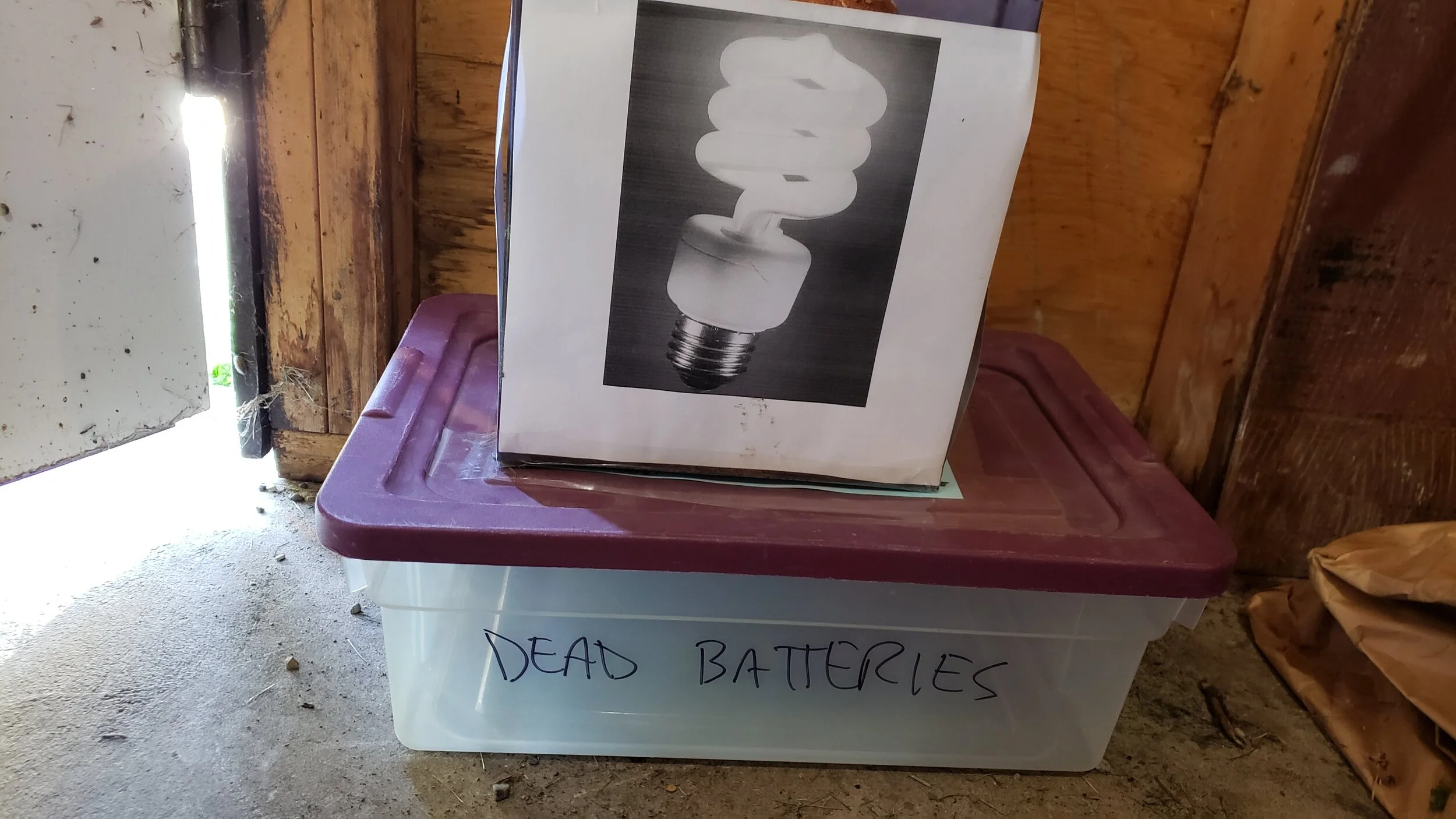
We now have both lightbulb and battery recycling receptacles in the shed!
Currently, most batteries (rechargeable, non-rechargeable, cell phone, and laptop) can be disposed at one stop, so put them in there and they will be taken out monthly or when it gets full.
Please don’t put car batteries in there, those just go to the fire station hazardous household waste drop off.
-The Education Committee
Submitted by Debbie Willis
The artist Sarah Johnson will be priming and painting one of the garbage disposal enclosures tonight and for most of the weekend, as part of the Sunnyhill Murals Project. I'll be the liason between the artists and membership, so if any issues come up, members can contact me through the phone list.
Submitted by James Jordan on behalf of Social Committee
Submitted by Cristian Badea-Hasasian on behalf of Grounds Committee
Jumping to a solution before a meticulous analysis and based on instincts and assumptions rather than rigorous technique and lots of data it is the root of the economic and, consequently, social situation we live in today.
Named "global warming" or "consumerism" or "unhealthy diets" or "depression", etc. us, as co-op members, are part of them and have a part in addressing them. Of course, most of us consider them as a problem.
Let's see what the connection to the Grounds would be. We, the members of the committee, started a new journey. We want to make a fast, intelligent, kind, economic and ecological impact on the social group giving us a chance to express our abilities and trust with our spending funds.
Therefore, in our few meetings we discussed more about what would be a solid framework for this committee in the long run rather than jumping around "temporary" solutions. In order to find our ways, we need information and a plan.
Information - we have some, collecting more through research, brainstorming, and asking around.
Plan - for now we should be reactive in order to be able to become proactive and efficient.
We want to have only solutions that are as cheap as possible, ecological, suitable to our coop social status and social standard. Most important the attempt is to be aware of the implications and trajectory into the future.
Example: the money in today's budget is totally unrealistic in today's extreme times - can volunteers do more than talking?
Some small projects have already started.
- Initially seen as "Assets", than as "Categories", than as "Interests" List is going to be a list with things GC (Ground Committee) has to deal with on a permanent level. Watch, maintain, improve, retire.
- The Food Jungle is our "baby" and now is the time to think how it will grow and all of us along it. Any baby comes with responsibilities, problems, and the thought "will we have more babies?"
- Playground inspection: hard to find inspectors. Can we do partial and frequent inspections? Yes, we can for the safety of our kids.
- A co-op vegetation map is going to be "gold" for future developments with vertical landscaping in mind and "can we do more for our planet?" focus.
- Sunnyside Murals Project may find a spot in SHC for visual enjoyment.
- Grounds Cleanup Event - can be fun with or without refreshments. We have to remove Blue Bell Flowers as well as other plants considered weeds. Maybe become a contest? With a little prize?
- Welcome of new members GC package will become available as grounds are an important part in our community year-round.
- Responsible and future aware revision of summer and winter Ground Contracts is going to be a challenge.
- Co-op's shed is full of tools and supplies. As gardening season is slowing down, it is time to inventory and organize things. And plan for improvements.
- Communication is the most important. Please help by (re)sending your list- small or large - of ideas, suggestions, problems, or achievements related to your unit's surroundings. Please keep it simple and send it to the dedicated email: SHCGrounds@shaw.ca with "idea" in the subject line.
Please join GC meetings as observers and maybe part of our positive brainstorming as we attempt to finalize our requirements list and determine the problems and furthermore good solutions. To find out when the next meeting is, simply ask at SHCGrounds@shaw.ca with "next" in the subject line.
Submitted by Mahlah Hansen on behalf of Grounds Committee
Submitted by Belle Auld on behalf of the Education Committee
What we are learning during our first pandemic
That we can still get together to eat and/or meet via Zoom
How to make pancakes without a recipe
That a person can spend approximately three hours watching videos on how to sew a mask
That a sewing machine repair shop is not considered an essential service
That it IS possible to garden yourself into exhaustion
That the 19 in Covid19 stands for the 19 pounds we gain
That wearing a mask at home prevents constant eating
That community is important
What we did not learn:
Why toilet paper??
Submitted by Cindy Schnee
UPDATE July 6
Unfortunately, the City has requested that volunteers not participate in goat herding this season due to COVID-19 restrictions.
We will have to watch and admire the goats from a distance.
The Vahana goats are coming! July 13-21, 2020
You can volunteer to hang out with 265 goats on 4 different shifts/day. We can accommodate just a few volunteers/day, so if you are interested, please send in your request as soon as possible. Due to COVID 19, visitors are not allowed in camp and goats may not be touched, so this is your chance to get close to them!
Shift 1: 9:00am-12:00 pm walk from home camp by Centre Street Bridge across McHugh Bluff to grazing areas in the west. Must be able to walk/climb on uneven surfaces, stand for entire shift and tolerate sun and heat.
Shift 2: 12:00 pm - 3 pm afternoon resting camp (West side of Bluff) – will be shady, can sit if desired, bring your lunch and chew your cud with the goats!
Shift 3: 3pm - 6 pm - could be a combination of sitting, walking and climbing. Sun or shade. Must be prepared for conditions such as shift 1 and 4. It depends on the goats!
Shift 4: 6 pm – 9 pm - evening grazing and walk back across McHugh Bluff to home camp at Centre Street. Must be able to walk/climb on uneven surfaces, stand for entire shift and tolerate sun and heat.
Please note: Shift times are approximate. It all depends on the goats!
Age 18 and up
Suitable footwear is necessary (good tread, high top) as well as a hat and water bottle that you can store to have hands free.
You will be asked to sign a waiver and there will be a short mandatory volunteer orientation sometime in early July.
Please contact Cindy at welovegoats3@gmail.com if you are interested, with date(s) and shift(s) you prefer, how many shifts you want to do total, as well as your t-shirt size.
Submitted by Rachel Rose on behalf of Social Committee
Submitted by Rachel Rose on behalf of Social Committee
Submitted by Belle Auld on behalf of the Education Committee
1. Incandescent light bulbs (regular old fashioned bulbs) or halogen light bulbs - go in the black cart. It is recommended that you put them in a puncture resistant, non-breakable container or wrap them in two layers of paper and tie it closed.
2. Compact fluorescent bulbs – these do not go in any bin.
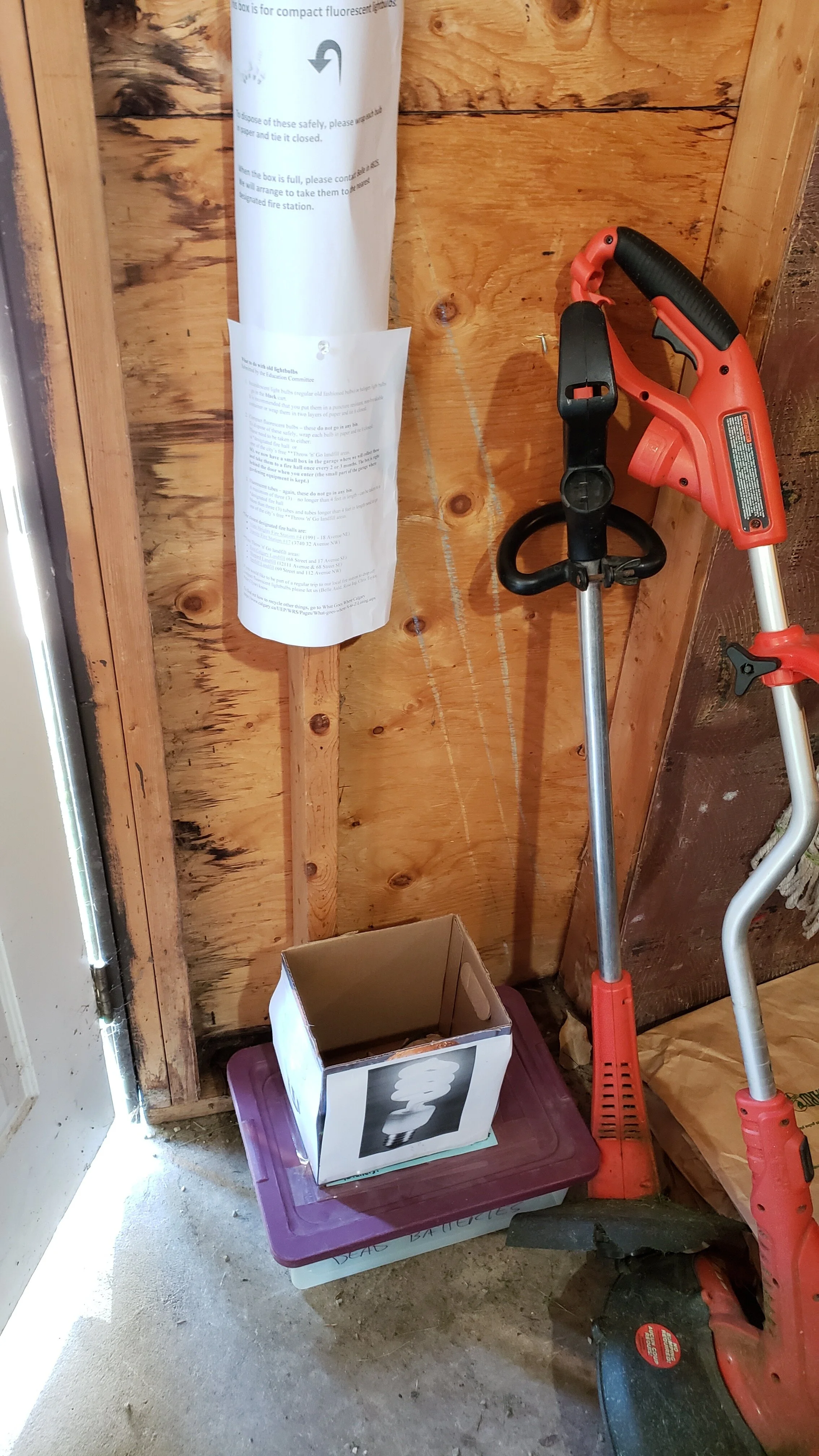
To dispose of these safely, wrap each bulb in paper and tie it closed.These need to be taken to either: -a *designated fire hall or -one of the city’s free **Throw 'n' Go landfill areas. SO, we now have a small box in the garage where we will collect these and take them to a fire hall once every 2 or 3 months. The box is right behind the door when you enter (the small part of the garage where gardening equipment is kept.)
3. Fluorescent tubes – again, these do not go in any bin.
A maximum of three (3) – no longer than 4 feet in length - can be taken to a *designated fire hall
More than three (3) tubes and tubes longer than 4 feet in length need to go one of the city’s free **Throw 'n' Go landfill areas.
*Our closest designated fire halls are:
Vista Heights Fire Station #4 (1991 - 18 Avenue NE)
Varsity Fire Station #17 (3740 32 Avenue NW)
**Free Throw 'n' Go landfill areas:
East Calgary Landfill (68 Street and 17 Avenue SE)
Shepard Landfill (12111 Avenue & 68 Street SE)
Spyhill Landfill (69 Street and 112 Avenue NW)
If you would like to be part of a regular trip to our local fire station to drop off compact fluorescent lightbulbs please let us (Belle Auld, Rose Ing, Chris Taylor, Peter Clyne) know.
To find out how to recycle other things, go to What Goes Where Calgary https://www.calgary.ca/UEP/WRS/Pages/What-goes-where/A-to-Z-Listing.aspx
*Stay tuned for information about old battery collection.
Submitted by Mia Rushton on behalf of Communications Committee
Following on from a recent member’s submission and another member’s suggestion, we have added Sunnyhill’s Articles of Incorporation and our Shareholder’s Agreement to the website. This information can be accessed on the Documents page of the website under the heading Important Documents.
If you have an idea or suggestion for us, please let us know!
sunnyhill.communications@gmail.com
Thanks :)
Submitted by Lisa Rouleau on behalf of Member Selection Committee
Hi all,
First of all, I am so sorry, and take full responsibility for the lateness of this announcement. Member Selection is delighted to welcome Heidi and Anna to 26 Sunnyhill Lane! They and their cat moved in at the beginning of April and they have already been active at meetings and socializing outside while beautifying their yard. We are happy to have you here, neighbours!
In other news, Member Selection has been discussing the situation with the one bedroom units in light of the open units and the P&D work with Urban Matters. First, thank you to Eric and the rest of the P&D team for such good communication -- we had a bit of a glitch in terms of everyone being in the know about the full discussion that has taken place this year, but it's 2020, so that kind of figures :-P
I'm writing to clarify what we understand to be the situation as it stands, and what the likely next steps are as they relate to the work of the Member Selection Committee.
FYI, Susan and Buzz, after years of excellent leadership with the committee (THANK YOU!! <3), have stepped down (for now, anyway), and Jaime Muneoka and I have taken on committee co-chair responsibilities. We will endeavour to work as best we can with Sarah Stephens, Laura Doram and Marzena Czarnecka, as well as the Board and other SHC committees for the well-being of our members and the co-op as a whole.
As of the general meeting in January, we were informed that the likely spot for any new build as we go forward -- looking to increase our occupancy along accessibility, affordability and aging in place ideals -- is where the four one-bedrooms from 762 to 768 are. That is not a fait accompli, but we must move forward with that possibility in mind and try to make this the least stressful time in the not-knowing that we can for everyone.
SO. Here is what we know, and what we hope will work as we continue to navigate this together as a community...
1. We do not yet know if other one bedrooms will be affected by the plans. P&D have communicated to us that the hope is we will have a more detailed plan from Urban Matters by some time in August. We have received confirmation from the Board that the vacant one bedroom (as of Aug 1) can be filled either Aug 1 or Sept 1. It will be offered to long-term SHC members of those units first, as motioned and carried in the Jan 2020 general meeting.
2. We have recommended to the Board that those members on the internal waiting list (members currently living in non-housing fit units) be left where they are on that list if that is their choice and not penalized for turning down a one bedroom unit that they then might have to move out of for the construction. We understand that those members may feel frustrated by the change in plans. But the co-op's intention as we move forward trying to expand our capacity is to preserve our community and our members' housing as best we can. The least stressful option is to leave people in their homes as long as we can, and not penalize them for not being in a housing fit while these changes are happening.
We are looking at a long term process here with, as we are all aware, a lot of unknowns. This is the current plan and it will need to shift as our knowledge of the plan shifts. Our hope is to keep everyone in the loop.
If you have any questions, concerns, comments, please do share them with the committee via the office or directly to me or Jaime.
Thank you, friends!
Lisa, for Member Selection
Submitted by Yvonne Sabraw on behalf of Grounds Committee
The Grounds Committee plans to meet twice a month through the summer, most likely on Monday evenings.
The next meeting is Monday July 6th, from 6:00 to 7:00pm, next to the SHC playground. As with all committees, any member who wants to attend is welcome.
Here are some highlights from recent meetings:
Inventory of SHC Grounds "assets" - we are developing a list and map of all the items (trees, gardens, garbage enclosures, tools, and so on) that Grounds is responsible for. In this way we can track what has been done to upkeep our assets. As everyone knows, managing the trees on our property is a big task. We plan to take pictures of each of the trees as part of the inventory and detail what interventions are needed over time. It would be great to have members let us know what concerns they have regarding the trees near their units specifically, and in the common areas generally. We may also need some help from members to identify what type each tree is.
The Grounds Committee's new email is SHCgrounds@shaw.ca . Please be aware that the previous email: shcgrounds@gmail.com, was deleted by the committee members who resigned in April. Therefore, if you communicated anything that needed attention to that email, you will have to resend it. If you sent concerns to the Grounds committee via the SHC office, Andrea has forwarded those emails to our new Shaw account.
Our contract for grounds maintenance is still with Curbside this summer but we will be reviewing options for the winter contract and really want general membership input into what is important for Sunnyhill in winter maintenance. As painful as it might be to cast your mind forward to the ice and snow of winter as you luxuriate in the sunny days of July, we will be asking for your thoughts soon.
Stay tuned for some group-efforts to maintain and tidy our common spaces this summer- we will be planning some things with social distancing measures in mind!
Submitted by Brenda Willman
We have good documents that govern our practices. The documents that deal with day to day details have been carefully presented, debated, written and re-written several times by the members! I concede that some of the Policies have perhaps been voted on at AGMs since the last full and comprehensive review of the Member Handbook, but I honestly don’t think much has changed, except with regard to the hiring of the Office Coordinator/manager, and that changed Buildings Policies (and were they all voted on and documented? Probably not and that is our collective error – no one to point fingers at but ourselves).
However, have members and boards continued to act as they see fit, provided ‘everyone’ is in agreement (that everyone being an interesting idea, since we really have to consider the entire membership and their wishes when changing how things are done)? Most definitely yes, and that was mentioned several times during the June 7th meeting.
There is so much to cover that I don’t know where to start
Think on some of the ways people can live together.
You can live in your own home and be subject to the regulations of the Village/Town/City in which your land is located, along with the requirements of your bank, along with the requirements of your co-habitants, if any. Who will pick up the garbage (in and out) who will provide safe drinking water, who will ensure that the lender (if one was involved) gets their money back? – which is equally to be considered.
You can live in a condo and be subject to the same as above, with the exception that some services will be provided by the condo-collective.
You can live in a housing cooperative and be subject to the same as above, with variations from condo agreements.
You can live on a commune (maybe as a Hutterite or as a member of Bountiful or Jonestown) and be subject to some of the same as above, likely with some privileges that come with being a religious organization (and such is usually the case). And maybe be with some detriments that come with living under the same (see Jonestown).
In all examples, there are agreements/Acts/regulations in place to protect landowners, big and small. Even communes exist in the country/municipality where they gather. Most of the legislation/regulation will ensure safety in the biggest sense of the word, i.e. safe drinking water, sewage collection, garbage collection, possibly schooling, etc. You might not get that on a commune.
Now narrow down your scope to the choice you have made. You decided to live in a Housing Cooperative and sign a Shareholders’ Agreement permitting/affirming/confirming your membership. You signed a business agreement as well as ‘signing-on’ to a more homey/touchy-feely tacit agreement to cooperatively live with other Shareholders in a hopefully mutually satisfactory and friendly environment. As such you have several documents protecting you as an individual, but (and what seems to be the missing link in so many differences and confrontations) these documents are also protecting you as a member at large who is paying rent and paying a mortgage and insurance, etc. for an entire housing complex comprised of 66 units built on rented land. You don’t own a unit. You own a mortgage and you have agreed to pay a land lease. To repeat - what comes with the mortgage and land lease is a housing complex of 66 units, one of which you may live in.
Here are our governing documents and what they mean to us.
MORTGAGE – we have borrowed money. We have to pay it back. We borrowed it to build the premises/buildings. Then we re-mortgaged everything again when we “got out of” the CMHC agreement. There may or may not be considerations for how we maintain the buildings under the terms of the current mortgage agreement – there probably are (there were requirements under the CMHC agreement but that is no longer in play and I have not read our mortgage agreement, and have never been provided a summary of same). Additionally and previously there were stipulations under the CMHC agreement on how much money a person could make upon move-in, how many subsidies should be provided and how much ($$) the subsidy should be – all stated in the $$ of the year of the agreement. This was revised throughout the years to keep up with inflation. I don’t know what, if any, stipulations in our mortgage govern our subsidy system any longer, and it shouldn’t matter because we do have a policy in place for that, and it was heavily discussed for months before finally accepted and it has stood the test of time, and has even served as an example for other coops leaving the loving arms of CMHC subsidies.
LAND LEASE – we live on rented land. The Landlord has rights. We don’t like some of them. We want our lease extended or to purchase the land. The Landlord has the right to say no, or say “yes but only if you do such and such”. Add in the extra complication that we want the land for non-profit housing purposes and you add on a layer of complexity(ies) that have been carefully considered by City Councilors that you and I have elected. For example, we must have accessible units if we want to stay on the land (which we all have agreed is a commendable goal and something we would like to strive for – but actualizing that goal is causing great distress amongst the members and introducing a huge financial load onto a tiny community). The land lease is also the source of the “right of ways” that were proffered by the City and sometimes lead us to a misunderstanding about what we can do where on our little patch of land – because some of “our” little patch is not really ours…the City just let us build a fence or garage there, but reserve the right to govern what happens on that land…that may be over-simplifying but it serves the purpose of Coles notes.
THE COOPERATIVES ACT and REGULATIONS– this is provincial legislation. I mention it all the time. If anyone has read it, they will come to understand that the reason I cite it constantly is to draw peoples’ attention to it. It is NOT a weapon. In fact, it covers the business end of things – and THAT is why I encourage people to read it. It does not limit our daily activities to any great extent, and so both Board members and members at large would do best to understand it and understand what DOES dictate our daily activities. Merely taking a look at the table of contents alone sheds light on what the Act provides for (and again) not only individuals belonging to a coop (and more specifically there is a section just for housing co-ops) but also for members belonging to a coop (ditto). Shareholders need protection from being evicted without due cause, but also need protection from having a crack house being set up on our collective property – which means we need legal ways in which to terminate that crack housee’s membership. Below this paragraph is a screen shot of the Table of Contents of the Act and of the Regulations (it’s the smaller list). Also is a screen shot of the TOC – expanded – for Part 18, where there is a special section for Housing Cooperatives. One can see that it is all business, but when expanded one can also see that it gets down to some details, especially regarding how Directors are elected, what their roles and duties are (including fiduciary), when we must meet, when we can meet other than when we must, how meetings are to be called, how many days notice, etc. all that business stuff which is predetermined by way of the Act and which we are obliged to follow. It tells us we must have Articles of Incorporation (special considerations for Housing Coops are under Part 18 392(1)) and it tells us we must have a Shareholders’ Agreement. It tells us what ByLaws we must have as a coop in general – see Part I Division 2 and it tells us what ByLaws we must have a Housing Coop in particular see Part 18 392(2)
ARTICLES OF INCORPORATION- re our Name, Purpose, Objectives, No Monetary Gain, the fact that we are a cooperative based on Shares, and a clause about the fact that we will carry on business, on a co-operative basis. It says the co-operative will comply with Part 18, Division 1 Housing Co-operatives, of the Cooperatives Act of Alberta and includes clauses, that we will have ByLaws and report any changes to our ByLaws to the Director of Cooperatives (a provincial position); it speaks to the number of Director’s we will have, and the address our registered office (place of business).
SHAREHOLDERS’ AGREEMENT – Everyone signs this before they move in, but it seems like some members have forgotten the terms of their agreement…for example I refer to the outcry several years ago when the Board requested confirmation of personal insurance from members and several members noted they did not know they were required to hold insurance policies. Our Shareholders’ Agreement includes clauses re General Provisions, the relationship is clarified as a right to occupancy and not a landlord-tenant relationship, what the occupancy rights are, general terms that the housing charge will be determined and will be paid – the details of which are described in the ByLaws and Policies, general clauses about provision of utilities and payment of utilities (provision and payment are not the same – the coop agrees that they will ensure you have access to water, electricity by way of pipes, and wires, but the member has to pay the monthly usage fees), right of entry, maintenance and alterations to units. There is a clause on withdrawal and termination which parrots the Act but one must prudently always revert to the Act when such situations occur, to ensure we are acting under current legislation. There is a clause about insurance and liability and this is where it says the Member agrees to carry personal insurance. There are an additional 13 clauses. You should all have a copy of your own Shareholders’ Agreement that you can reference for more details.
BYLAWS – many of our bylaws come straight out of the act – review the Tables of Contents I have inserted to find out more about that. Our ByLaws has sections on the following subjects:
General Matters
Corporate Seal
Capital Stock
Membership
Disputes
Transfer of Membership
Withdrawal of Membership
Death of a Member
Termination of Membership
Share Re-purchase
Meetings
Board of Directors
Officers
Payment of Directors and Officers
Board Meetings
Liability of Directors and Officers
Committees and task forces
Records
Financial Management
Housing Charge
Reserve funds/Banking/Borrowing
Signing Officers
Amendments of Policies – i.e., Currently states Major policies can only be passed, amended or rescinded at a general meeting by special resolution. I am strongly against changing this as was recently proposed by our recent Board. I believe members should approve all policies board policies or not. It also currently provides that the board can pass any policy that is not designated as a major policy. We collectively decided at a GM that, for now, all policies are MAJOR, hence requiring member approval
The priority of Sunnyhill's documents (and only Sunnyhill’s documents– in all cases the Provincial Act and Regulations will take priority and in some cases our Mortgage and/or Land Lease will also take priority over Sunnyhill’s documents) – WHICH ARE IN ORDER OF PRIORITY:
Articles of Incorporation
By-laws
Shareholders' Agreement
Relationship between the Coop (believe it or not you are one of the Shareholders and represent the Coop as an entity) and individual members (you live here in a unit – and some individual rights come with being a member living in a unit) You have a business relationship with yourself!
Winding up of Sunnyhill
And next comes policies, which all members approved at various GMs before and after the major work was done ( 2 or 3 times). Below is the list of Policies we had in 2008, and again I don’t think it has changed much. I am willing to review all minutes since 2008 to ensure that any changes are captured to revise the document prepared in 2008.
Here is a high level list of what is in our Policies section of the Member Handbook. Please note section 1.2 is “what is good governance”. I am not kidding about having mentioned governance over and over in the last 12 years.
General and Background Information
General Policies and Board Policies – there might be some new ones to add here which may or may not have been approved yet.
Caregiver Expenses for Document Signing Sessions
Collection Keys for all Units
“Reside” and “To Occupy” a Unit
Move-in Policy
Move-out Policy both always under consideration and not sure if any official changes have been made, but this is one area where Committee members have definitely done what they deem appropriate and not necessarily in agreement with what has been documented. In fact, several situations are not covered and the Committee has to use common sense.
Members required to sign 2004 Shareholders’ Agreement Policy – yes some Members had never returned their signed copy and we as a coop had not followed up.
Best usage of Space/Housing Fit Policy – separate from Housing Charge Policy but related
Directors Liability Insurance Policy
Termination of Membership – Appeals
Parking Policy
Wildlife Policy
l changes have been made, but this is one area where Committee members have definitely done what they deem appropriate and not necessarily in agreement with what has been documented. In fact, several situations are not covered and the Committee has to use common sense.
Members required to sign 2004 Shareholders’ Agreement Policy – yes some Members had never returned their signed copy and we as a coop had not followed up.
Best usage of Space/Housing Fit Policy – separate from Housing Charge Policy but related
Directors Liability Insurance Policy
Termination of Membership – Appeals
Parking Policy
Wildlife Policy
Financial Policies
Housing Charge Calculation and Collection Policy
Personnel Policies
Privacies Policies
SHC Representatives
Standing Purchasing Committee
Youth Committee
Member Selection Policies – same comments as Move-in, Move-out policies
Grounds Policies
Integrated Pest Management Policies
Cyclical Unit Inspections
Buildings/Maintenance Policy/Procedures (Unit Maintenance and Improvements)
Unit Maintenance at a Glance/Troubleshooting Tips
PROCEDURES - At the very bottom of this list are procedures – those being the ways in which the Policies are carried out. For example, we may say it is a policy that before any work can be done on a Unit, the Buildings Committee (and now, more currently the Office Coordinator) must pre-approve the work (with perhaps an exception policy in place for emergencies). The procedure is that we use Purchase Orders to signify approval (and to facilitate payment), and the procedure would dictate who keeps the purchase orders, when they should be available, etc. For another example, it is Grounds Policy that the Grounds Committee will make available grass seed for reseeding lawns. It does not stipulate (which would amount to Procedure) where it has to be purchased, stored, etc. As a general rule, the payment for the seed would fall under our spending policy which was proposed back in 2008 but I’m not convinced it was ever approved; we never got around to completing the policies that were required.
If you’ve read this far, you can understand that we have a tendency to blur the lines between POLICY and PROCEDURE, but that is not uncommon and we should not beat ourselves up for it. THE END.
Submitted by Planning and Development
Planning and Development is inviting members to:
AN INTRODUCTION TO MODA
June 18th, 7:00 pm - 7:30 pm
Zoom (link: https://bit.ly/2AeyZVJ)
Modern Office of Design + Architecture (MODA) is the Calgary-based architecture and interior design firm that Urban Matters is working with to envision what our aging-in-place, accessible housing might look like. MODA is the same firm that did the design work for our 2 and 3 bedroom in the fall. They offer a collaborative, team-oriented approach to all projects, big or small. MODA’s work ranges from single family residences to institutional projects such as libraries, schools, art galleries and fire halls to multifamily and mid-scale office, retail and commercial buildings.
MODA will provide an introduction to the memberships about how they work and the process they will lead the membership through as we work to design a new building.
To facilitate the discussion, we are asking members to send questions to Planning and Development sunnyhill.planning.development@gmail.com by SUNDAY JUNE 14TH. We will collate the question and send them off to MODA. They will work them into their presentation.
MODA website: http://moda.ca/
Email if you need the phone number to join the meeting.
sunnyhill.planning.development@gmail.com
Looking forward to seeing you all there!
P and D
Submitted by Bruce Eason
Please have a look at the link below for a list of our household furniture,
garden tools, etc. Most items are free as we are moving out of Sunnyhill.
https://www.techduck.ca/stuff/
More will be added.
"Everything must go!"
There is a very old set of MacIntosh gear from the iconic Big Brother Super
Bowl half-time TV commercial that will find its way to the list if it is
still here in the next little while.
That's it for now.
Cheers,
Bruce #779
Submitted by Susan Russell on behalf of Member Selection Committee
On May 1st, SHC said goodbye to long-time member, Karol Garner, who moved from unit #762. Wishing you all the best Karol, you will be missed! New member Rita Fields will be moving into unit #762 on June 1st. Welcome to SHC Rita!